
← Back to Research & Discovery
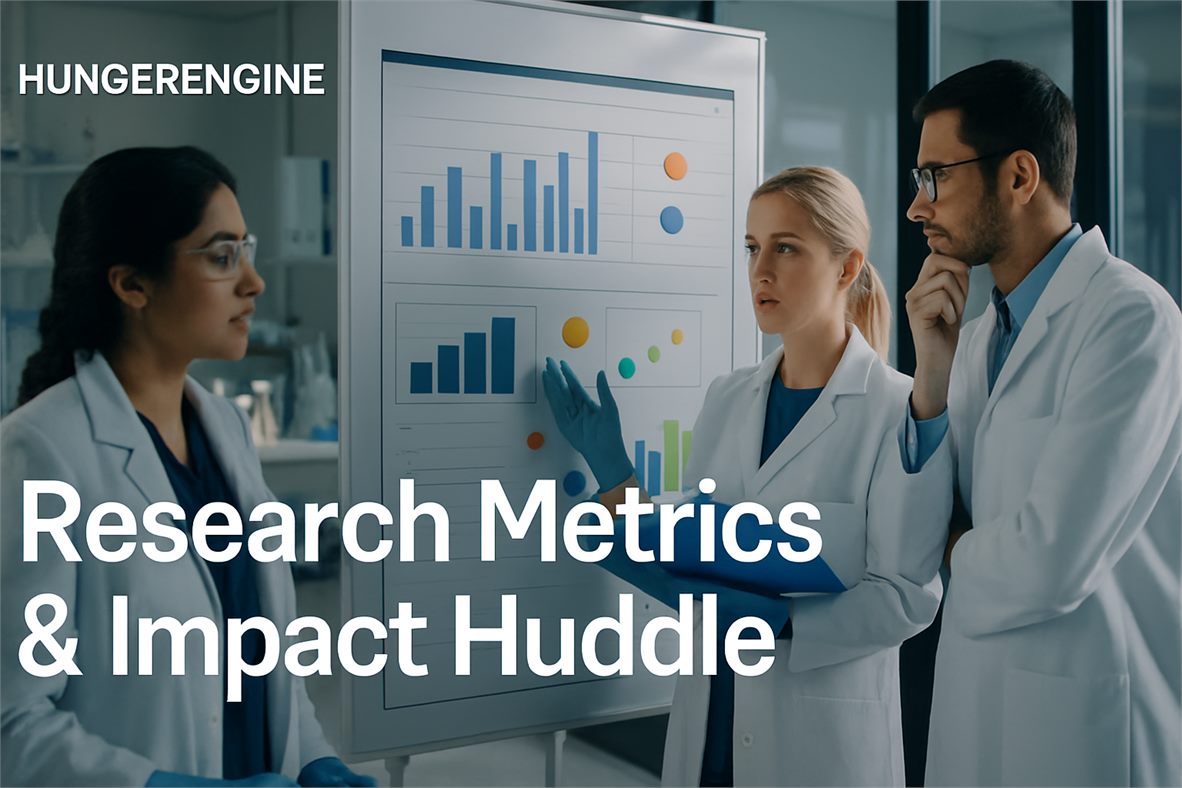
Research Metrics & Impact Huddle
A lightweight KPI huddle template for research teams to prioritize experiments, review evidence quality, and align activity with impact goals.
Research Metrics & Impact Huddle
Run a short, repeatable meeting that helps research teams make data-driven trade-offs, celebrate learning, and stop low-value work before it consumes time and budget.
What you'll understand and accomplish
This huddle shows you how to use a tight cadence to track a small set of meaningful metrics, surface evidence-quality issues, prioritize the next experiments, and log decisions and blockers so your team spends more time on high-impact work. It helps teams translate observations into clear actions while preserving lessons in your research knowledge base.
Who benefits
Designed for research and development teams, lab groups, product R&D, clinical researchers, innovation teams in manufacturing, evaluation teams in nonprofits, and small teams experimenting with AI or prototypes. It’s especially useful when several parallel experiments compete for limited resources and faster feedback reduces wasted effort.
Where it fits in the Intelligent Research & Discovery domain
This huddle is an operational practice inside the broader Intelligent Research & Discovery ecosystem: it complements experimental design, reproducibility reviews, and knowledge preservation by turning measurement and evidence checks into a rapid, civic-minded team habit. Use it to connect experiment outcomes to hypothesis libraries, reproducibility checks, and your organization's learning records.
Short, practical agenda (15–30 minutes)
Use this checklist as a template and adapt the timing to your team:
- KPI snapshot — review 3–5 signal metrics tied to current hypotheses (quick trends, not raw dashboards)
- Evidence-quality check — identify any replication, measurement, or data integrity concerns
- Experiment spotlight — prioritize the next experiment or decision and state the expected evidence
- Blockers & resourcing — surface impediments and assign owners
- Learning & celebration — call out what you learned and update the team’s knowledge record
Practical examples
Examples of how teams use the huddle:
- A university lab uses a weekly huddle to spotlight experiments needing replication and to reallocate bench time after failed runs.
- A biotech startup prioritizes lead candidates by reviewing go/no-go metrics and evidence strength before spending assay budget.
- A manufacturing R&D group reviews pilot metrics and product-defect signals to decide whether to scale a process change.
- A nonprofit evaluation team tracks program outcome measures and refines data-collection plans when evidence quality drops.
Tips to avoid common pitfalls
Keep the huddle effective by avoiding vanity metrics, aligning incentives with impact, running cadence consistently, and tying every metric back to a hypothesis or decision. Rotate facilitators, invite cross-functional voices when needed, and record outcomes in your knowledge system so the team can learn from past trade-offs.
Run this free huddle with your team: use the agenda above, adapt the checklist to your context, and add results to your project’s knowledge record so decisions and learnings stay discoverable.
Make useful resources part of something bigger.
The Hunger Engine is moving toward living domains, toolkits, and collections that people and organizations can explore, acquire, tailor, extend, and improve. A useful resource can become part of a personal collection, team toolbox, site-specific domain, or shared enterprise capability.
Start with what you're hungry to improve. As your needs grow, collections can bring together knowledge, audits, forms, dashboards, data, AI, integrations, and other capabilities without requiring you to start from scratch.