
← Back to Leadership & Collaboration
Build Organizations That Learn Together
Design feedback loops, rituals, and leadership practices that make learning repeatable across teams — for managers, team leads, and change agents.
Build Organizations That Learn Together
Turn occasional training and one-off fixes into repeatable learning systems that surface insight, spread good practice, and accelerate improvement across teams and units.
What this resource helps you understand and do
You will learn how to design simple feedback loops, create knowledge-sharing rituals, and adopt leadership behaviors that make continuous improvement everyday work — not an optional project. The focus is practical: assess where learning is fragile, run small experiments, capture tacit knowledge, and scale improvements without bureaucracy.
Who benefits
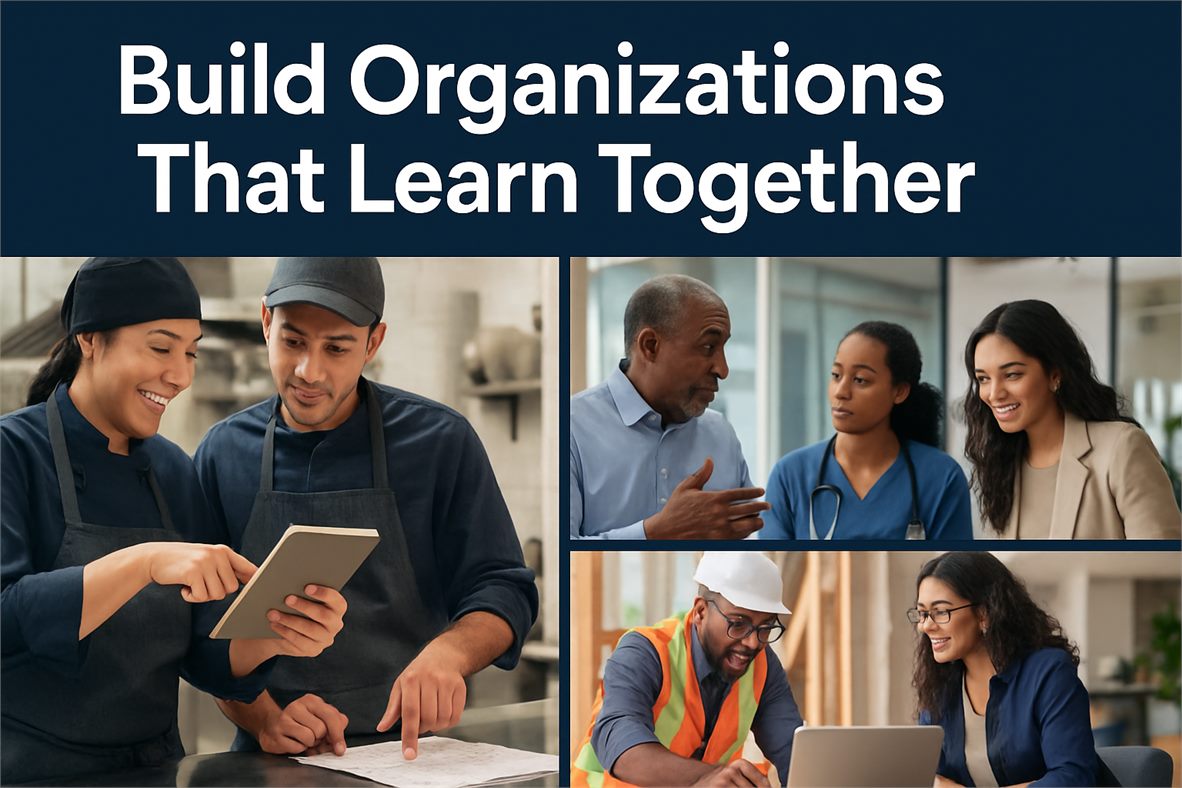
This guide is for managers, team leads, improvement coaches, operations leads, nonprofit directors, school administrators, and small-business owners who need reliable ways to spread what works. It’s especially useful for front-line teams and supervisors in service businesses, healthcare clinics, manufacturing floors, skilled trades, and research or education settings.
Practical examples you can adapt
- A restaurant manager who turns nightly shift debriefs into a two-minute checklist and a shared improvement log so common service issues are fixed within days rather than months.
- A maintenance team that formalizes shift handovers into a short knowledge checklist and a “lessons logged” board so troubleshooting knows where to start.
- A community health clinic that runs monthly case-review huddles and a simple RACI for follow-up changes to protocols, reducing repeated errors and preserving institutional knowledge when staff turnover occurs.
What you’ll practice and measure
Practice small, repeatable cycles: observe, capture, test, and share. Start with a learning audit (where knowledge lives, who holds it, what breaks when people leave), then design one lightweight feedback loop and one sharing ritual. Measure early outcomes like faster problem resolution, fewer repeated errors, or more reused practices — and use those results to expand what’s working.
Common pitfalls to avoid
Don’t treat learning as episodic training or a box to check. Avoid heavy, one-size-fits-all documentation that never gets used. Watch for leaders who delegate reflection but never model it. These mistakes turn learning into wasted effort and leave tacit knowledge vulnerable when people move on.
How this fits with Leadership & Collaboration
Organizational learning depends on the same foundations as strong teams: trust, clear communication, coaching, and shared purpose. Use this resource alongside practices for better meetings, conflict resolution, and coaching to turn individual learning into collective capability.
Next steps: run a quick learning audit, pilot a daily or weekly huddle, and document one repeatable practice that others can copy — then expand from there.
Make useful resources part of something bigger.
The Hunger Engine is moving toward living domains, toolkits, and collections that people and organizations can explore, acquire, tailor, extend, and improve. A useful resource can become part of a personal collection, team toolbox, site-specific domain, or shared enterprise capability.
Start with what you're hungry to improve. As your needs grow, collections can bring together knowledge, audits, forms, dashboards, data, AI, integrations, and other capabilities without requiring you to start from scratch.