
← Back to Organizational Intelligence: Learn, Decide, and Improve Together
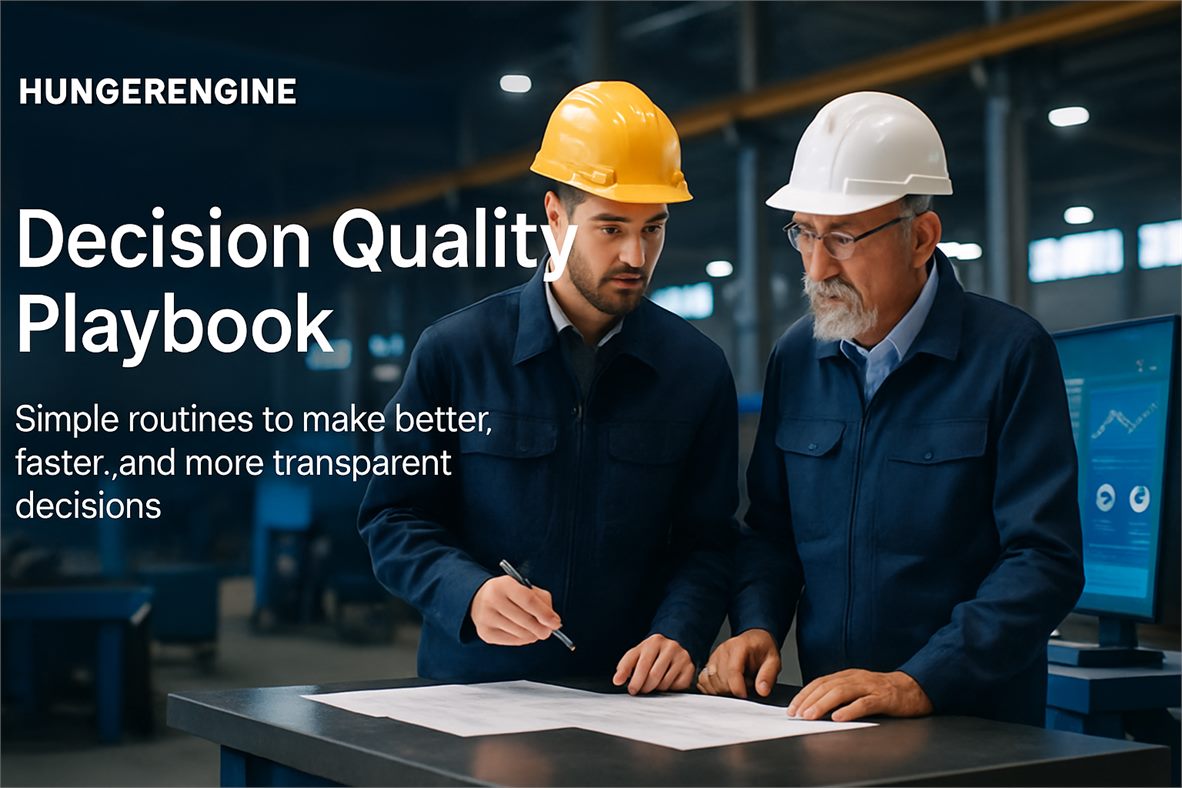
Decision Quality Playbook: Simple Routines to Make Better, Faster, and More Transparent Decisions
Lightweight templates, pre-mortems, and decision records to help teams surface assumptions, compare options, and learn from outcomes.
Decision Quality Playbook: Simple Routines to Make Better, Faster, and More Transparent Decisions
This playbook gives teams practical, repeatable routines—pre-mortems, decision records, simple templates, and facilitation recipes—that surface assumptions, speed alignment, and turn decisions into shared learning.
What you will understand and be able to do
You will learn small, repeatable practices that make reasoning explicit and outcomes visible. After using the playbook you will be able to:
- Structure a decision so tradeoffs and assumptions are clear
- Run a quick pre-mortem to reveal hidden risks and weak assumptions
- Keep concise decision records that capture why a choice was made and how success will be measured
- Create lightweight facilitation recipes to reduce rework and repeated debates
Who benefits
This resource helps small teams, managers, consultants, nonprofit leaders, skilled trades forepersons, operations supervisors, product teams, and service-business owners who need predictable ways to make and revisit decisions. It is especially useful where choices affect other people, budget, safety, quality, or customer experience and when you want decisions to become organizational learning rather than one-off outcomes.
How to use it in real work
Start small and practical: choose one recurring decision (hiring, vendor selection, process change, scope change) and apply a template and a pre-mortem in a single meeting. Examples:
- Roofing contractor: compare two material options by documenting cost, lifespan, install time, and common failure modes before committing.
- Hospital unit: run a pre-mortem before changing a clinical protocol to surface safety risks and training needs.
- Nonprofit program manager: use a decision record to capture why one pilot was funded and which metrics will determine scale-up.
- Manufacturing team: document a process-change decision, expected quality gains, and how to test the change in a single shift.
How this connects to Organizational Intelligence
Decisions are a primary source of organizational knowledge. When teams make reasoning explicit and preserve decision records, learning accumulates instead of being lost. Use these routines alongside your other knowledge practices—meeting huddles, post-implementation reviews, and curated reference collections—to reduce repeated debates, reveal biases, and improve future choices.
Try it now: pick one decision this week, run a two-step pre-mortem, and record the outcome. Use the playbook’s templates as a starting point and adapt them to your context.
Make useful resources part of something bigger.
The Hunger Engine is moving toward living domains, toolkits, and collections that people and organizations can explore, acquire, tailor, extend, and improve. A useful resource can become part of a personal collection, team toolbox, site-specific domain, or shared enterprise capability.
Start with what you're hungry to improve. As your needs grow, collections can bring together knowledge, audits, forms, dashboards, data, AI, integrations, and other capabilities without requiring you to start from scratch.